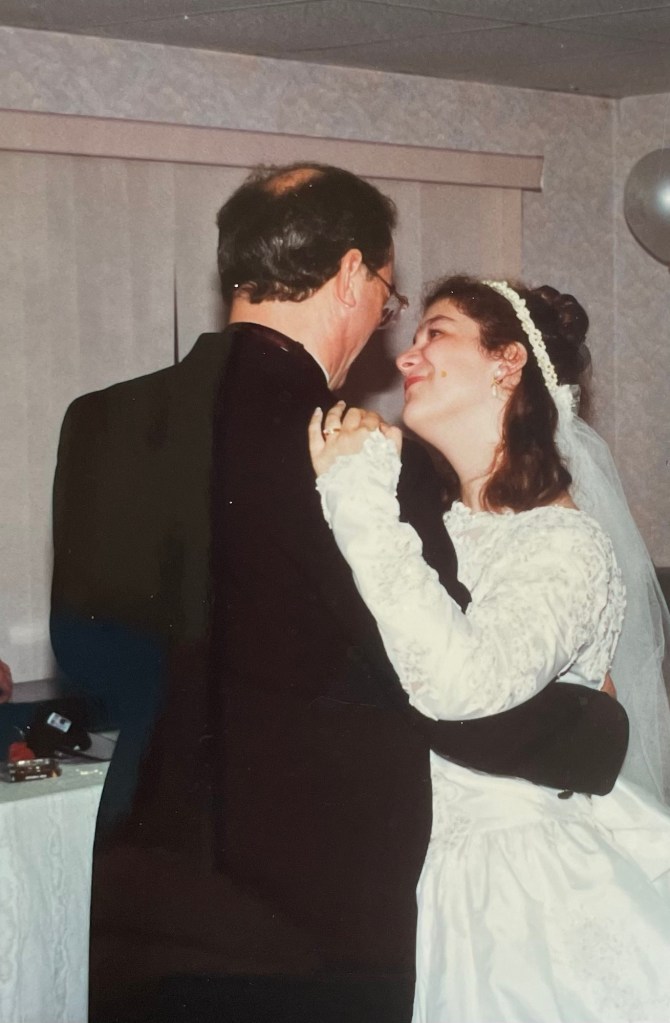
From my earliest childhood memories, I remember my dad occasionally walking into a room where music was playing, taking my mother’s hand, and they would begin to dance without saying a word. They wouldn’t dance long, usually not even an entire song, but the look on my mother’s face was always as if she was thrilled.
In my early teens, my mother decided to teach me to dance. She said it was necessary for my education because “girls like to dance.” She taught me that in a partner dance, one person would need to lead, and the other would need to follow. She spoke about how the leader and follower communicate without using words. Everything other than my feet seemed to understand. After a few minutes, she realized this task would be much more challenging than expected. She taught me the steps of a very simple slow dance and, with my father’s help, showed me how to change the tempo and dance to just about anything with these simple steps. That worked for a while, but then people stopped dancing like that and moved on to something more modern.
I didn’t understand dancing. I didn’t understand why people were drawn to it. I wanted to dance and understood why I wanted to dance; in my mother’s words, “Girls like to dance.” What girls liked drove most of my decisions as a teenager.
When I met my wife, doing anything together was fun. I saw where dancing and doing something in complete unison could be great fun. Still, unfortunately, the dancing gene must not be in my DNA.
It was my wife who taught me that dancing is nonverbal communication. Where a handshake might be a nonverbal sentence, a dance could be an entire conversation. She reminded me of when we were in India with the Banjara tribals, and when they were going to do something together as a village, the entire village would dance to say that in this task, they were together. When the task was finished, the whole village would dance together to celebrate finishing the task together.
For the most part, I have been able to avoid dancing. However, my wife and I were forced to be the only couple on the dance floor, with everyone watching, a few embarrassing times that were meant to be moments of honor. I wish I had paid more attention to my mother’s instructions as they would not only have helped in those moments but would have also helped in my relationship with the Lord.
I discover a common element in those times when I ask when I have been the most effective for the Lord. The Lord was doing something, and I was trying to flow with him. It was most noticeable on mission trips when I would spend my days not trying to initiate anything new but just trying to keep up with the Lord. It was the Lord leading and me following. I usually would sense what the Lord was doing without him saying a word and move with it. It is like dancing with the Lord. In this dance of doing something together, the Lord reveals himself.
Dancing and music are common to all of mankind. Native tribes with no former history of outside contact have all had some form of music and dance. It appears that God has made us this way, and it helps us understand how to relate to the Lord and follow his lead.
My footwork doesn’t seem to bother the Lord at all. My desire to do what the Lord is doing and follow his lead seems enough. Beyond that, the Lord makes up for all of my shortcomings, and the end result is pure joy.


 Walking the path
Leave a reply to Don White Cancel reply