
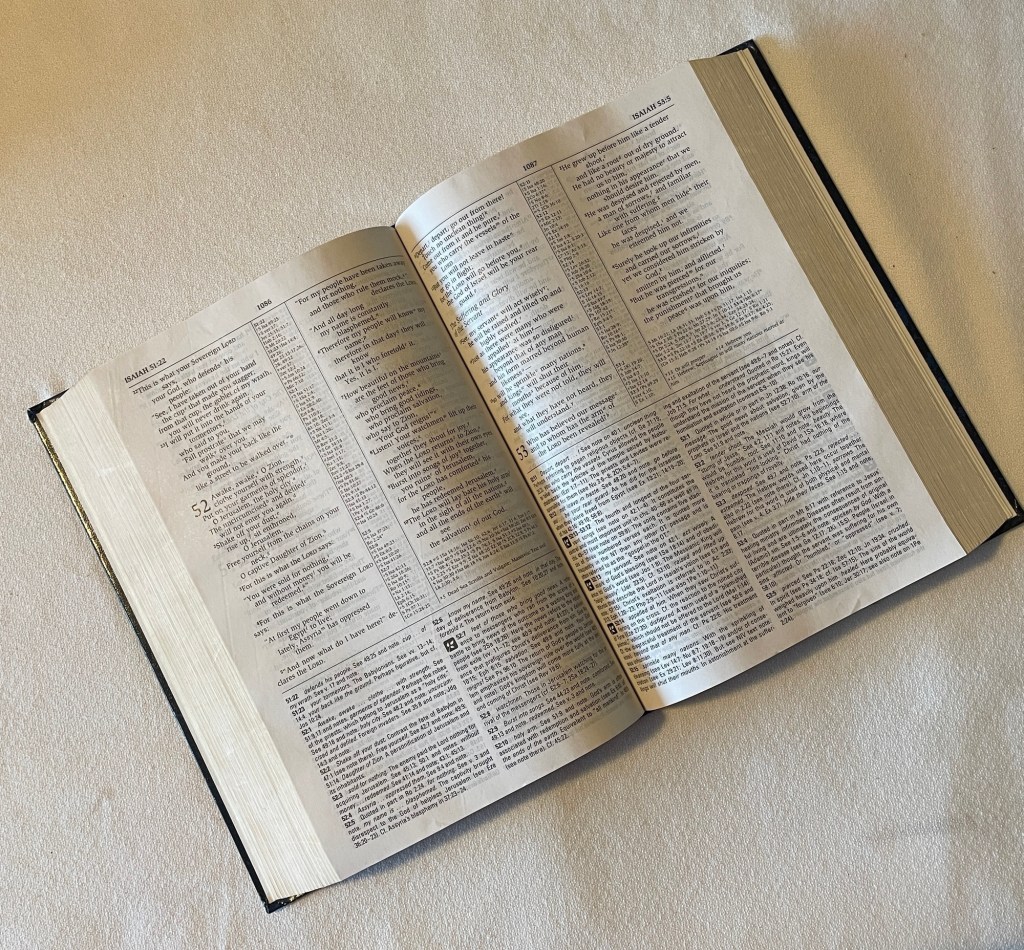
About 1/3 of the Old Testament and part of the New Testament are written in a way that makes the writer’s intent easier to understand. They are written in ancient Hebrew poetry that rhymes thought rather than sound.
Synonymous: the second line rephrases the first in different words.
Antithetic: the second line contrasts with the first, as in many Proverbs.
Expansive or synthetic: the second line adds to, develops, or completes the first line.
Isaiah 53:1-6 NIV
1Who has believed our message
and to whom has the arm of the Lord been revealed?
2 He grew up before him like a tender shoot,
and like a root out of dry ground.
He had no beauty or majesty to attract us to him,
nothing in his appearance that we should desire him.
3 He was despised and rejected by mankind,
a man of suffering, and familiar with pain.
Like one from whom people hide their faces
he was despised, and we held him in low esteem.
4 Surely he took up our pain
and bore our suffering,
yet we considered him punished by God,
stricken by him, and afflicted.
5 But he was pierced for our transgressions,
he was crushed for our iniquities;
the punishment that brought us peace was on him,
and by his wounds we are healed.
6 We all, like sheep, have gone astray,
each of us has turned to our own way;
and the Lord has laid on him
the iniquity of us all.
The easiest guide is a modern translation such as the ESV (English Standard Version), NIV (New International Version), or NRSVue (New Revised Standard Version Updated Edition), which sets poetry in indented lines. The KJV prints everything as numbered prose verses, which hides it.
Books that are almost entirely poetry
- Psalms. Several are alphabetic acrostics, where each line or stanza begins with the next Hebrew letter: Psalms 9–10, 25, 34, 37, 111, 112, 119, and 145.
- Proverbs. Chapters 1–9 are extended poems, chapters 10–29 are mostly two-line sayings, and 31:10–31 (the capable wife) is an acrostic.
- Song of Songs.
- Lamentations. Chapters 1–4 are acrostics. Chapter 5 has 22 verses, matching the alphabet, but doesn’t follow it.
- Job. Poetry from 3:1 to 42:6, framed by a prose prologue (chapters 1–2) and epilogue (42:7–17).
- Ecclesiastes is mixed. It contains clear poems (1:2–11, the “a time to” passage in 3:1–8, and the meditation on old age in 12:1–8), but translations disagree on how much of the rest to set as verse.
The prophets
Prophetic oracles were mostly delivered in verse.
- Mostly poetry: Isaiah (apart from narrative sections, notably chapters 36–39), Hosea, Joel, Amos, Obadiah, Micah, Nahum, Habakkuk, and Zephaniah. A few have short prose stories, such as Hosea 1 and 3 and Amos 7:10–17. Habakkuk 3 is a full psalm, complete with “Selah” and musical directions.
- Mixed: Jeremiah alternates poetic oracles, concentrated in chapters 1–25 and 46–51, with prose sermons and narrative. Zechariah’s visions in chapters 1–8 are mostly prose, while chapters 9–14 are largely poetry.
- Mostly prose with poems embedded: Ezekiel has poetic laments, notably chapters 19 and 27 and the lament over the king of Tyre in 28:11–19. Jonah is a prose story except for his prayer in 2:2–9. Daniel includes short hymns of praise, such as 2:20–23 and 4:34–35, and the vision of the Ancient of Days in 7:9–10 and 13–14.
Poems inside the narrative books
Several of these are thought to be among the oldest Hebrew texts in the Bible.
- Genesis: Lamech’s boast (4:23–24) and Jacob’s blessing of his sons (chapter 49).
- Exodus: The Song of the Sea (15:1–18) and Miriam’s song (15:21).
- Numbers: The priestly blessing (6:24–26), the Song of the Well (21:17–18), and Balaam’s oracles (chapters 23–24).
- Deuteronomy: The Song of Moses (chapter 32) and the Blessing of Moses (chapter 33).
- Judges: The Song of Deborah (chapter 5).
- 1 Samuel: Hannah’s song (2:1–10).
- 2 Samuel: David’s lament for Saul and Jonathan, “How the mighty have fallen” (1:19–27), his song of deliverance (chapter 22, nearly identical to Psalm 18), and his last words (23:1–7).
- 1 Chronicles 16:8–36, a psalm stitched together from Psalms 105, 96, and 106.
The narrative books also quote from lost poetry collections: the Book of Jashar (Joshua 10:13, 2 Samuel 1:18) and the Book of the Wars of the Lord (Numbers 21:14).
The New Testament
It’s mostly prose, with some exceptions:
- The songs in Luke 1–2, written in the style of Hebrew psalms: Mary’s Magnificat (1:46–55), Zechariah’s Benedictus (1:68–79), the angels’ Gloria (2:14), and Simeon’s Nunc Dimittis (2:29–32).
- Early Christian hymns that scholars believe were quoted in the letters, though the identifications are debated: Philippians 2:6–11, Colossians 1:15–20, and 1 Timothy 3:16. The prologue of John (1:1–18) is often read as a hymn adapted into the Gospel.
- Revelation’s hymns, sung around the throne (4:8, 4:11, 5:9–13, 15:3–4, 19:1–8), and the dirge over Babylon in chapter 18.
- Jesus’ teaching uses Hebrew parallelism heavily, as in the Beatitudes and the Lord’s Prayer, even where it’s printed as prose.
- Greek poets quoted by Paul: Aratus in Acts 17:28, Menander in 1 Corinthians 15:33, and Epimenides in Titus 1:12, the line about Cretans always being liars.


Leave a Reply